
Automotive & Engineering Injection Molding Materials
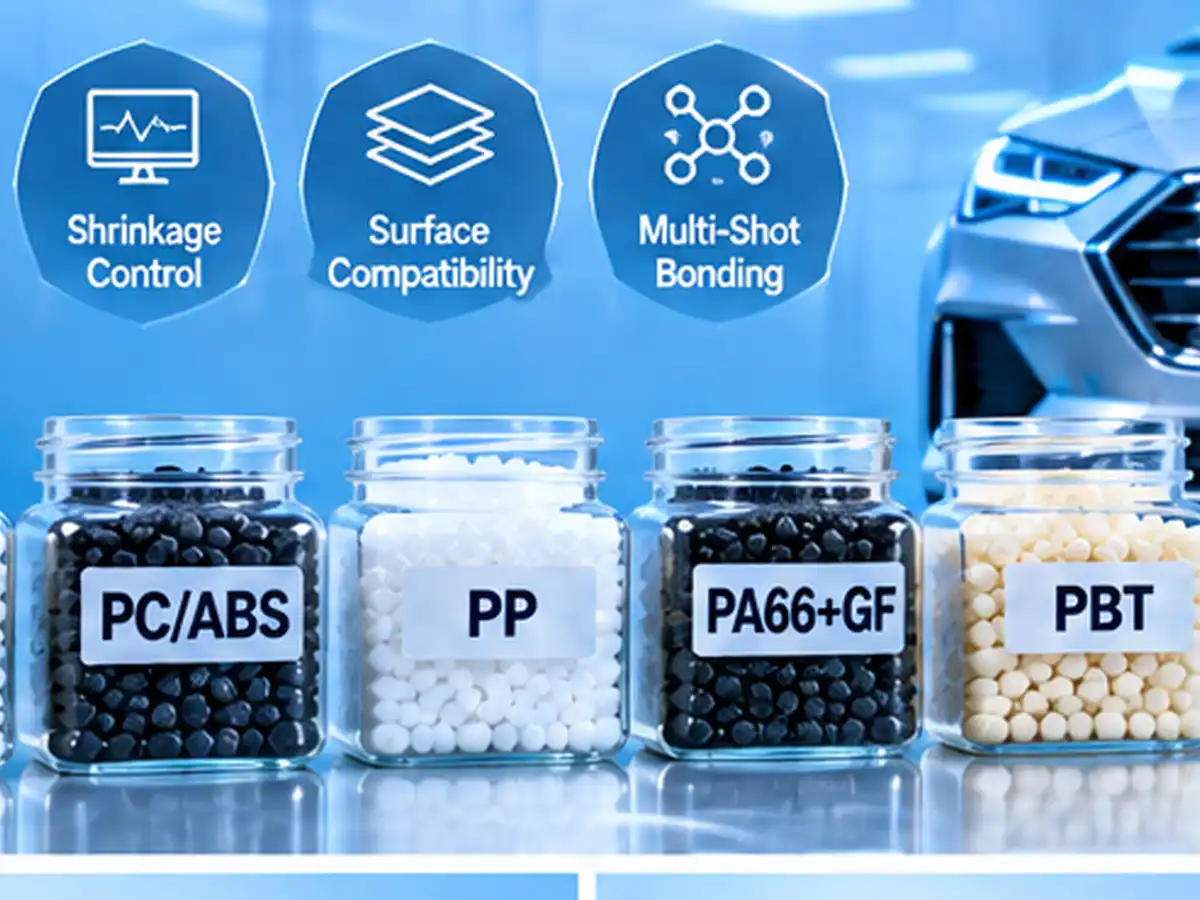
Learn more about us as Ningbo Mude Molding Technology Co., Ltd. provides end-to-end resin rheology analysis, shrinkage compensation, and surface compatibility engineering for ABS, PC/ABS, PP, PA66+GF, PBT, and TPU. From raw property characterization to full-scale injection molding, we ensure structural integrity and Class-A automotive finishes.
Resin Validation Telemetry
CAE VerifiedCAD/CAE/CAM Integration: We calibrate mold cavities using certified OEM resin datasheets, balancing thermal cooling circuits against anisotropic shrinkage to eliminate warpage before cutting tool steel.
Common Injection Resins & Automotive Applications
Ningbo Mude Molding Technology Co., Ltd matches anisotropic shrinkage rates, thermal transitions, and rheological behavior to exacting Tier-1 automotive and precision electronics specifications across mission-critical industries.
PP (Talc / EPDM Modified)
Bumper fascias, interior door panel carriers, pillar trim panels, and trunk wheel liners.
ABS & PC/ABS Alloys
Front radiator grilles, instrument panel retainers, center console bezels, and exterior door handles.
PA6 / PA66 (15%–50% GF)
Under-hood structural covers, pedal brackets, cooling shroud modules, and active grille shutter (AGS) vanes.
PC & PMMA (Optical Grade)
Full-width headlamp lenses, rear light bars, two-shot ambient light guides, and central display frames.
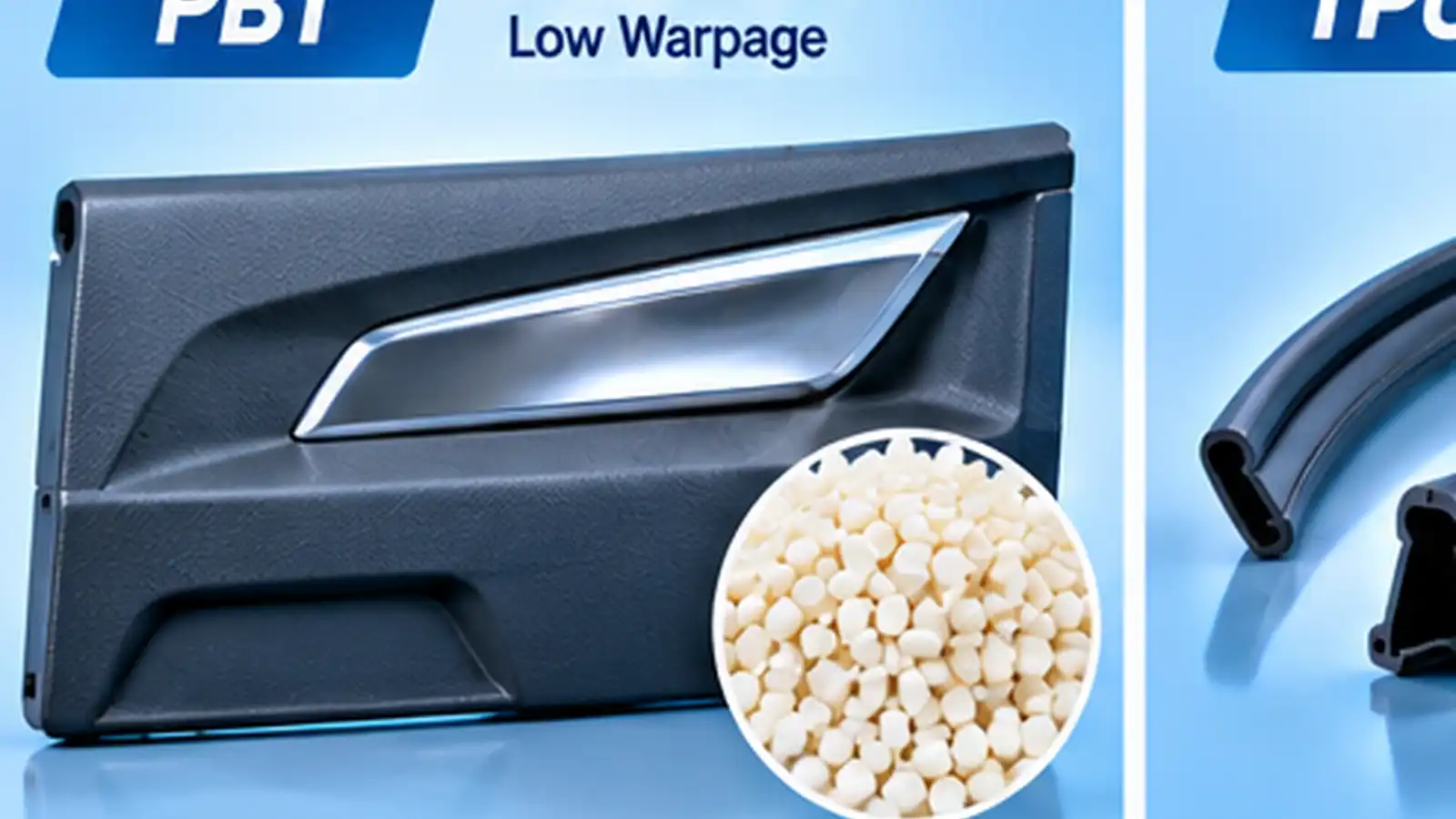
PBT & PBT+PET Alloys
Direct-metallized headlamp reflector cups, high/low voltage wiring connectors, and ECU sensor housings.
TPU & TPE Formulations
Dual-shot overmolded buttons, secondary sealing gaskets, wire harness grommets, and steering dust boots, with similar elastomer formulations used in premium home-appliances.
Precision Tool Compensation Governed by Molecular Orientation Analysis
Mude Molding integrates resin-specific molecular orientation and differential cooling data into 3D tooling models, ensuring repeatable dimensional stability across global OEM programs. Discover why-chosen-Mude represents the trusted engineering benchmark for tight-tolerance tooling.
Resin Selection for Premium Surface Finishes
Ningbo Mude Molding Technology Co., Ltd bridges polymer rheology with Class-A tooling standards. By tailoring resin grade selection to mold thermal dynamics, we eliminate cosmetic defects, flow blush, and adhesion failure across automotive high-gloss mold-in-color, decorative chrome plating, IMD/INS films, and backlit ambient lighting assemblies.
Dynamic Variothermal Mold Control vs Standard Injection
In wide-format front grilles, pillar covers, and illuminated cockpit bezels, Mude Molding matches polymer crystallization kinetics with conformal variothermal tooling. This suppresses weld line freeze-in, relaxes residual molded-in stress, and ensures defect-free depth of gloss—a key reason why-chosen-Mude engineering is trusted by tier-1 automotive suppliers.

Drag slider horizontally to evaluate micro-surface reflection and defect suppression.
Piano Black High-Gloss (Mold-in-Color)
We qualify ultra-high-flow PMMA/ABS and tailored PC alloys processed under precise dynamic thermal regulation. Holding tool steel temperatures at 110°C to 130°C throughout melt filling guarantees complete replication of polished tool cavities, completely removing the cost and scrap rates of secondary paint lines across automotive components and precision home-appliances mold applications.
- Delivers Ra < 0.02 μm Class-A mirror finish directly from the mold cavity.
- Completely eradicates visible weld lines, gate jetting, and flow hesitations.
- Achieves high surface hardness meeting up to pencil hardness rating 2H.


Automotive Exterior Chrome Plating
Long-term plating reliability depends on consistent butadiene rubber sphere size and homogenous dispersion. We process certified electroplating-grade resins such as Chi Mei PA-727 and LG MP165, maintaining minimal shear orientation to deliver dense chemical anchoring during subsequent etching.
- Complies with strict CASS 48-hour accelerated copper corrosion tests without blister defects.
- Eliminates micro-pinholes, plate-skipping, and uneven surface conductivity.
- Withstands severe automotive thermal shock cycles spanning -40°C to +85°C.
In-Mold Decoration & Insert Molding (IMD/INS)
Integrating pre-formed graphic films with molten resin requires calculated cavity filling pressure and gate shear controls. Mude Molding utilizes low-internal-stress optical grade PC and specialized PP backbones, preventing foil displacement, ink washout, and thermal wrinkling across contoured Automotive Interior Accessories geometries.
- Protects sensitive multi-layer graphics from high-temperature polymer melt degradation.
- Regulates film tensile elongation across tight radii and complex 3D interior contours.
- Eliminates peripheral edge delamination, micro-creasing, and optical birefringence.


Dual-Color Translucent & Ambient Lighting
Intelligent vehicle cockpits demand laser-sharp backlit graphics and uniform illumination. We engineer two-shot combinations pairing automotive-grade optical PC with opaque light-blocking ABS, balancing volumetric shrinkage across both shots to eliminate light bleeding along boundary shut-offs.
- Delivers distinct optical shut-offs with complete elimination of parasitic light haloing.
- Preserves cohesive inter-material bonding under repeated environmental aging tests.
- Ensures crisp icon edge fidelity conforming to OEM display luminance uniformity standards.
Multi-Shot Injection Molding Material Compatibility & Interfacial Bonding Guide
Chemical affinity between resin layers dictates structural reliability and seal integrity in multi-component molding. Ningbo Mude Molding Technology Co., Ltd. analyzes interfacial surface energy, melt boundary temperatures, and molecular diffusion rates to engineer high-adhesion 2K and 3K parts on rotary tool systems.
| Rigid Substrate (1st Shot) | Overmold Resin (2nd/3rd Shot) | Bonding Mechanism | Bond Rating | Target Application |
|---|---|---|---|---|
| ABS (Terpolymer) | TPU (Aromatic / Aliphatic) | Interfacial polymer chain interdiffusion driven by compatible ester/urethane polarity and thermal fusion. | Excellent Bond | Automotive gear selector grips, consumer electronics enclosures, power tool dampening sleeves. |
| PC (Polycarbonate) | TPE / TPU (Ester-Based) | High surface-energy compatibility yielding a cohesive boundary layer resistant to peel and shear. | Excellent Bond | Illuminated IP67 switch assemblies, optical bezels, automotive sensor housings. |
| PP (Polypropylene) | TPV / TPE (SEBS-Based) | Non-polar polyolefin cross-diffusion across the melt boundary under elevated tool core temperatures. | Excellent Bond | Door acoustic baffles, HVAC duct gaskets, under-hood fluid sealing interfaces. |
| PA66 / PA6 (+GF Reinforced) | TPU (Ether / Ester) | Moderate hydrogen bonding limited by crystalline boundaries; requires undercut features to resist dynamic peel. | Interlock Required | Powertrain wiring brackets, active shutter linkages, high-vibration structural mounts. |
| PC / ABS Alloy | PMMA (Optical Grade) | Amorphous polar chain entanglement creating a transparent melt boundary free of optical knit lines. | Good Bond | Capacitive center-console panels, dual-shot ambient light guides, HUD bezels. |
| PP (Polypropylene) | TPU (Polyurethane) | Polarity divergence prevents chemical bonding; zero adhesion leads to immediate boundary delamination. | Incompatible | Not feasible without specialized coupling primers, modified resin alloys, or complete mechanical capture. |
Tooling Countermeasure Guidelines for Moderate & Non-Polar Pairings
When resin chemistries prevent natural chemical fusion, Ningbo Mude Molding Technology Co., Ltd. integrates mechanical anchoring features into the primary substrate to lock the overmolded material permanently in place.
Dovetail Undercuts & Grooves
Machined directly into the primary substrate with 30° to 45° reverse taper angles. As the secondary elastomer cools, volumetric shrinkage pulls material tightly into the undercut geometry, preventing edge lift.
Through-Core Flow Riveting
Precision through-holes in the rigid core allow the soft resin to flow through and form countersunk rivet heads on the reverse side, locking thin overmolding surfaces without increasing shut-off complexity.
Laser Micro-Texturing & Anchoring
Controlled laser etching to VDI 30–36 standards on the substrate contact area expands the interfacial contact surface by up to 240%, providing micro-porous retention for semi-compatible engineering resins.
Heavy-Duty Multi-Component Presses Built for Complex Rotary Molds
Equipped with 3-shot injection presses up to 1420T (featuring rotary table and orthogonal secondary barrel configurations) and dedicated 2K rotary systems, Ningbo Mude Molding Technology Co., Ltd. maintains tight process windows across both injection stages to ensure dependable interfacial bonding without flashing or boundary voids.
CAE Simulation & Metrology Verification
Aligning Rheological Data with Tooling Geometry
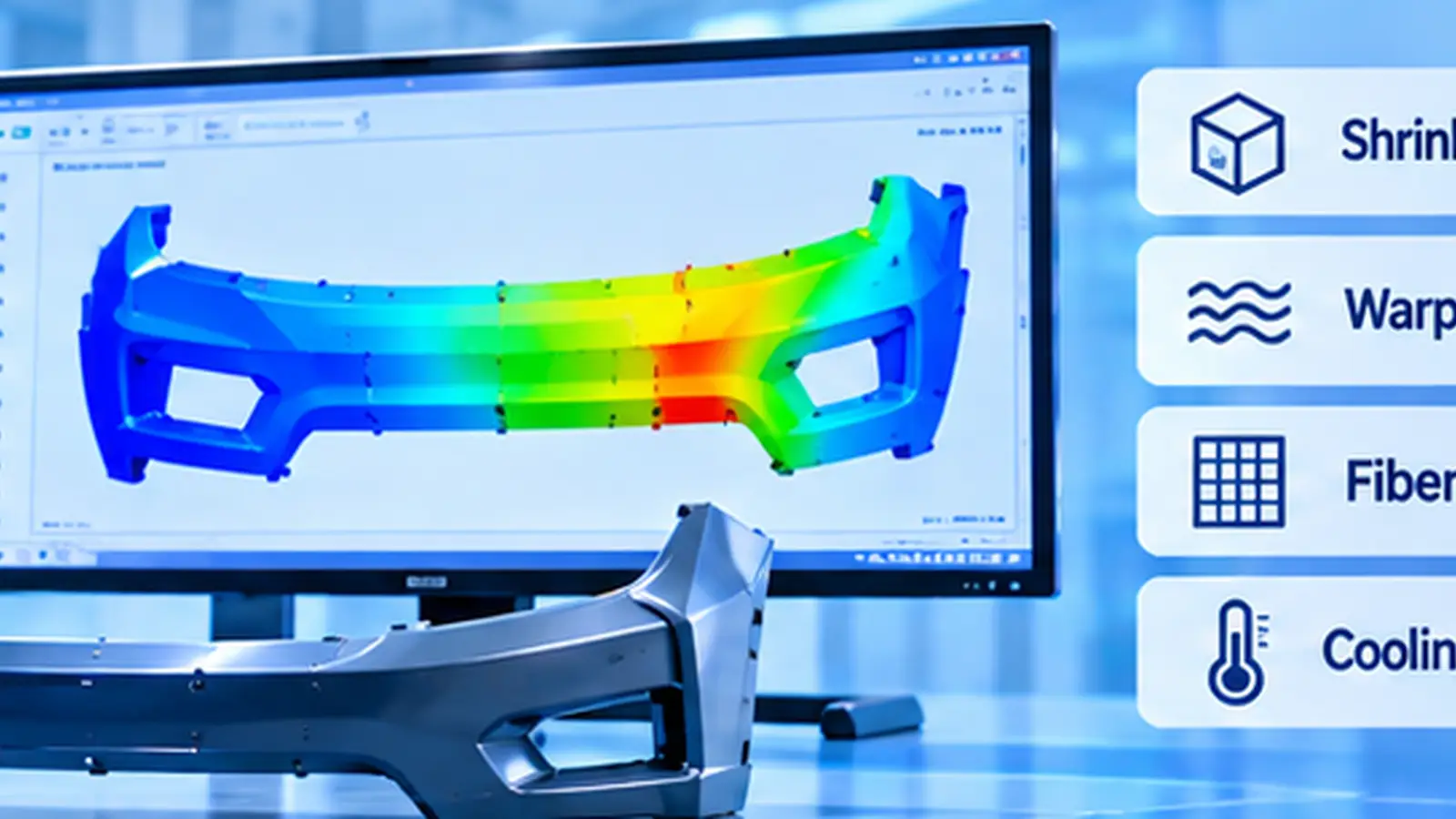
Mude Molding integrates Autodesk Moldflow rheology simulation, native 3D CAD datasets, and CMM metrology to ensure tight dimensional repeatability on high-tolerance components.
~0.1%
Flow vs. transverse variance in amorphous PC & ABS
0.5%
Anisotropic differential managed in semi-crystalline PP & PA66
Resin Shrinkage & Warpage Engineering Control
Resin Shrinkage Management and Dimensional Tolerance Control
Polymer crystallization dynamics and fiber orientation determine tooling cavity scaling, cooling optimization, and long-term part stability across automotive systems and home appliances.
- 1
Amorphous vs. Semi-Crystalline Volumetric Sizing
Amorphous polymers such as ABS and PC exhibit nearly uniform shrinkage along flow and cross-flow directions, with variance rarely exceeding 0.1%.
Semi-crystalline resins like PP and PA66 exhibit directional shrinkage differentials exceeding 0.5%, requiring zone-specific cavity scaling factor compensation.
- 2
Fiber Orientation Mapping & Reverse Warpage Compensation
For reinforced grades such as PA66-GF30, Autodesk Moldflow accurately forecasts fiber orientation tensor vectors and thermal deflection tendencies.
Tooling engineers apply reverse warpage pre-deformation into 3D core and cavity CAD models prior to 5-axis CNC high-speed milling.
- 3
Melt Flow Index (MFI) Lot Stability Auditing
Inbound raw material testing verifies melt flow rate fluctuations remain strictly within ±5% of resin manufacturer material specifications.
This strict resin audit prevents tooling parting line flashing, short shots, and inconsistent cavity packing pressure during sustained serial production.
- 4
Thermal Balancing via Conformal Cooling Channels
Tool cooling lines are designed around resin thermal conductivity values to eliminate localized heat sinks and non-uniform solidification fronts.
Conformal cooling layouts homogenize cavity surface temperatures, relieving molded-in residual stresses and preventing post-ejection geometric twist.
Predictive Tooling Engineering for Demanding Polymers
Ningbo Mude Molding Technology Co., Ltd embeds polymer-specific anisotropic shrinkage parameters directly into 3D tooling datasets during upfront engineering.
Our CAD/CAE methodology couples Moldflow warpage analysis with bridge CMM verification to maintain rigid automotive tolerances on glass fiber reinforced plastic injection molds.
Automotive Standards Compliance & Global Resin Partnerships
Ningbo Mude Molding Technology Co., Ltd maintains verified tooling engineering datasets for leading automotive grade plastic suppliers worldwide. As detailed in our company brief, we design and manufacture high-precision injection molds aligned with strict OEM rheology, shrinkage, and flammability specifications.
Certified Raw Material Suppliers
Extensive tooling experience with premier polymer formulations and certified supply chains
Global Brand Resin Processing
Pre-compensated tooling calculations tailored for advanced automotive grades. We specialize in SABIC PC injection mold design, structural polyamides, and dimensionally stable copolymer alloys.
- SABIC Lexan™ PC & Cycoloy™ PC/ABS tooling expertise
- BASF Ultramid® PA & Covestro Makrolon® PC melt flow analysis
- DuPont™ Zytel® glass-reinforced structural mold builds
- Celanese Celcon® POM tight-tolerance shrink management
OEM Safety & Olfactory Protocols
Precise mold thermal control to prevent polymer chain scission. We build molds optimized for low VOC interior plastics and UL94 V0 injection materials to guarantee emission and flame compliance.
- VDA 270 interior cabin olfactory odor limits (Grade ≤ 3.0)
- UL94 V-0 and HB flammability ratings without resin thermal degradation
- SAE J2527 exterior accelerated weathering and UV resistance
- Volkswagen TL 52 series & GM GMW homologation conformity
NEV Lightweighting & High-Voltage
Tooling tailored for electrical insulation, structural mass reduction, and battery enclosures. We integrate conformal cooling and balanced venting for fiber-filled resins and microcellular foaming.
- Flame-retardant PA66-GF30 molds for EV battery covers and trays
- High-voltage busbar connectors (Dielectric tracking CTI 600V)
- Microcellular foaming (MuCell®) PP door carriers (-15% mass)
- High-wear cavity inserts resisting abrasive glass fiber erosion
Delivering Strict OEM Requirements at Scale
As an engineering-driven tooling enterprise deeply rooted in automotive exterior trim and Automotive Interior Accessories, Ningbo Mude Molding Technology Co., Ltd maintains verified trial datasets and series production records across leading domestic and global OEM vehicle programs.
Instrument Panels & Low-VOC Trims
VW TL52062 and GMW3059 compliance using low-emission modified talc-filled PP-EPDM resins.
Validation: VDA 277 total carbon content and formaldehyde emissions kept well below OEM limits.
Tooling Solution: Sequential valve gate hot runners eliminating weld lines across Class-A grained surfaces.
High-Voltage Battery Disconnect Units
Halogen-free PA66-GF30 with UL94 V-0 flame certification down to 0.75mm nominal wall sections.
Validation: 600V comparative tracking index (CTI) with zero electrical breakdown under humidity testing.
Tooling Solution: Hardened 1.2344 steel cores with anti-abrasive PVD coatings ensuring 500,000+ shot life.
Aero Exterior Spoilers & Grilles
High-impact PC/PBT and AES alloy tooling validated under SAE J2527 exterior cycle testing.
Validation: Accelerated xenon-arc weathering for 2,500 hours with color shift Delta E < 1.5.
Tooling Solution: Conformal cooling lines balanced with dynamic mold temperature control to eliminate warpage.

Resin Rheology Analysis & Tooling Engineering Consultation
Need qualification support for specialized automotive polymers? Discover why-chosen-Mude partnerships earn industry trust: our mold engineers assist in selecting compatible automotive grade plastic suppliers, calculating differential shrinkage rates, and running Moldflow simulations to prevent shear degradation, gas traps, and excessive residual stresses.
Frequently Asked Questions on Injection Molding Materials
Engineering solutions addressing tool steel wear, high-gloss surface integrity, interior VOC compliance, and prototype resin validation.